

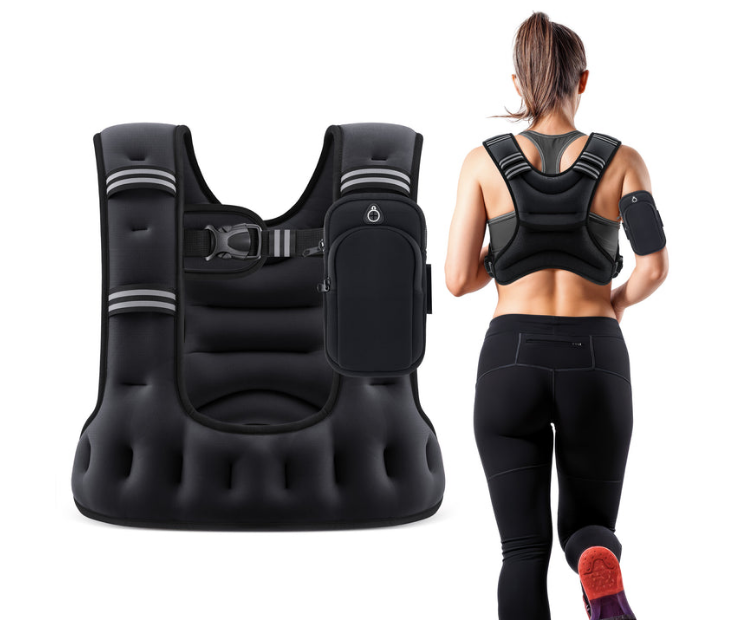
5 Ways a Weighted Vest Transforms Leg Day
We’ve all been there. You’re in your living room, knocking out your third set of bodyweight squats, and you realize… you aren’t really feeling the burn anymore. Your legs have adapted. You’re going through the motions, but the “zeal” is gone.
The traditional answer is to go to a gym and get under a heavy barbell. But not everyone has the space, the budget, or the desire for a bulky squat rack.
At Zelus Fitness, we believe in a better way to break through plateaus. By adding a Zelus Weighted Vest to your lower-body routine, you aren’t just adding weight; you’re fundamentally changing the mechanics of your workout.
Here are five ways a weighted vest transforms your leg day from “basic” to “beast mode.”
1. Hands-Free Progressive Overload
The biggest mistake people make when trying to level up their squats at home is holding a single dumbbell or a heavy water jug. While this adds weight, it also limits you. Your grip strength often fails before your legs do, and holding weight in front of you can pull your torso out of alignment.
With a Zelus Weighted Vest, the resistance is strapped directly to your center of mass. Your hands are free to help with balance, and you can focus 100% of your mental energy on your quads and glutes. It’s the simplest way to keep “overloading” your muscles as you get stronger.
2. The “Deep Core” Wake-Up Call
When you squat with a barbell on your back, it’s easy to accidentally “cheat” by leaning too far forward. When you wear a Zelus X-Shape Vest, the weight is distributed evenly across your chest and back.
To stay upright under that 12lb, 20lb, or 40lb load, your core (abs, obliques, and lower back) has to fire at 100% capacity. You’ll find that a “vested” squat feels like an ab workout and a leg workout rolled into one.
3. Explosiveness Without the Impact
If you want toned, powerful legs, you need “explosive” movements like jump squats or box jumps. However, doing these unweighted can eventually feel too easy, and doing them with dumbbells can be awkward and dangerous for your wrists.
The vest stays snug to your body. It allows you to perform plyometric (jumping) movements with added resistance while keeping your center of gravity stable. You get the metabolic spike of a heavy lift with the athletic benefits of a jump.
4. Perfecting Your Form (Biofeedback)
Surprisingly, a weighted vest can actually improve your squat form. Many beginners struggle with “falling forward” or keeping their heels on the ground.
The downward pressure of a Zelus Comfort Vest provides what trainers call “biofeedback.” It pushes your center of gravity down through your heels, naturally encouraging you to sit back into your hips rather than forward into your knees. It’s like having a gentle hand on your shoulders guiding you into the perfect “bucket” squat.
5. Time Under Tension (TUT)
Because the vest is a part of you, you can slow down your reps safely. Try a “4-2-1” Squat:
- 4 seconds on the way down.
- 2 seconds holding at the bottom.
- 1 second exploding back up.
Doing this with a 20lb vest creates immense “Time Under Tension,” which is the secret sauce for muscle growth (hypertrophy). By the 10th rep, those “basic” squats will feel like a brand-new exercise.
The Zelus Leg Day Challenge
Next time you train legs, swap your standard routine for this:
- 15 Vested Air Squats
- 20 Vested Alternating Lunges
- 10 Vested Jump Squats
- Rest 60 seconds. Repeat 4 times.
The Verdict
Basic squats are a great start, but your legs deserve a challenge. Whether you’re using our 8lb Starter Vest or our 60lb Heavy Duty model, you’re giving your lower body the resistance it needs to change.
